WATCH: Former adviser talks about being with Bush on 9/11
National News

Audio By Carbonatix
3:50 PM on Wednesday, September 9
Dave Mason
(The Center Square) - Brian Montgomery remembers riding in the presidential motorcade in Sarasota, Fla., on a warm and sunny morning of what would become one of America’s darkest days.
“As we’re pulling up to Emma Brooks Elementary School, the gentleman sitting behind me in the motorcade car sat up, leaned forward and said, ‘A plane just hit the World Trade Center,’ ” said Montgomery, who oversaw President George W. Bush’s events outside the White House as director of the Office of Presidential Advance.
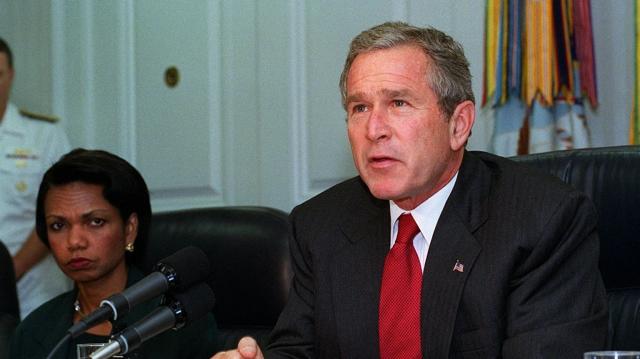
“I immediately thought it was a terrorist act,” Montgomery, 70, told The Center Square, noting the World Trade Center in New York City was not on any flight path. He added that after walking into the school and greeting the principal, Bush soon went into a room and got on the phone with National Security Adviser Condoleezza Rice.
Montgomery will talk about being with Bush on Sept. 11, 2001 during a 25th anniversary commemoration at 6 p.m. Pacific time Friday at the Ronald Reagan Presidential Library and Museum in Simi Valley, Calif.
Montgomery talked to The Center Square Wednesday via a video call from Alexandria, Va., the Washington, D.C. suburb where Montgomery lives today and works as the founding partner of Gate House Strategies, a company that provides advisory services for mortgage lending.
Montgomery recalled Bush entering a second-grade classroom at the Florida school just as a second jet crashed into the World Trade Center, this time the South Tower. Montgomery and other Bush administration officials watched United Airlines Flight 175 on a TV with rabbit ears in a holding room near the classroom.
Montgomery noted White House Chief of Staff Andrew Card said at that moment, “That’s it. I need to go to tell the president.”
Card and Montgomery entered the classroom through different doors, and Card leaned down and whispered to Bush, “A second plane hit the second tower. America is under attack.”
“The president sort of nodded his head,” Montgomery recalled.
Reporters in the classroom were aware of the attack on the World Trade Center, but the students weren’t, Montgomery said. He explained Bush decided against saying anything to avoid creating a panic. The president continued to sit quietly for a few more minutes and listen to the children read aloud from the book “The Pet Goat.”
Afterward, Bush went immediately back into the holding room and talked on the phone with Vice President Dick Cheney in Washington, D.C., Montgomery recalled. “And Ari Fleischer, who was the press secretary, had already started writing a statement.”
Bush and his team went next door to the school auditorium, where an audience of mostly teachers, with some students, parents and reporters, had gathered to hear the president discuss education reform. Instead, Bush stood there before TV cameras and read Fleischer’s statement about terrorists attacking the World Trade Center.
Montgomery recalled the look of worry on students’ faces. “I realized we had inadvertently scared them. They were hearing this for the first time.”

“America Is Under Attack” Inside President Bush’s 9/11 Morning
What was it like inside the room when President George W. Bush learned that America was under attack on September 11, 2001?
“By the way, the Secret Service the whole time is basically saying, ‘We need to get out of here’ because they were worried someone was going to fly a plane into the school where we were,” Montgomery said. The agents' concerns rose on a day on which another hijacked plane crashed into a Pentagon and a third jet, believed to be bound for the U.S. Capitol, crashed in a field near Shanksville, Pa., when passengers fought hijackers for control of the cockpit.
The crew on Air Force One, meanwhile, was ready to get Bush out of Sarasota quickly. After reading the statement, the president left with his team in the motorcade to Sarasota Bradenton International Airport.
“When we got to the airport, the engines were already running. We weren’t back in our seats, and we were already rolling,” Montgomery said.
Air Force One, a 747, took off like it was an F/A-18 fighter plane, Montgomery said.
Bush wanted to return immediately to the White House, but his advisers, who included military aides, recommended a more secure location, Montgomery said.
“I don’t call it a doomsday playbook, but there were sites around the country where the president could go in emergencies,” Montgomery said.
Instead of Washington, D.C., Air Force One took Bush and his team, along with reporters, to Barksdale Air Force Base in Louisiana, where they landed at 11:45 a.m. Eastern time. The last commercial plane above the continental U.S. landed around 12:16 p.m., following the Federal Aviation Administration's decision to ground flights. That meant other than some emergency planes, Air Force One had U.S. airspace to itself, Montgomery said.
At 2:50 p.m., Air Force One landed at Offutt Air Force Base in Nebraska, the headquarters of the U.S. Strategic Command, commonly known as STRATCOM.
That evening, Bush and his team flew on Air Force One, escorted by F-16 fighters, to Andrews Air Force Base, then traveled by helicopter to the White House, where the president addressed the nation that evening from the Oval Office. Montgomery noted the president was careful to point out that the religion of Islam was not America’s enemy, that the enemies were terrorists.
“I tell you, some parts of the day seem like yesterday. Other parts seem like 25 years ago,” said Montgomery, who incidentally flew with Bush on the Air Force One that's on display at the Reagan Library.
Montgomery talked about something he kept as a reminder of 9-11. It came from Bush’s visit on Sept. 14, 2001, to Ground Zero in New York City, where the president stood with a bullhorn on top of an SUV, flattened by all the debris, and addressed a crowd that included first responders.
Rain on that morning turned the dust at Ground Zero into a gray paste that stuck to the shoes of Montgomery and others. “We had to keep moving along and couldn’t clean our shoes. When I got home that night, I was exhausted,” Montgomery said. "I hadn’t slept in four days.”
Instead of cleaning his shoes, Montgomery said, he put them in plastic bags that he stored in a shoebox for permanent storage. “They’re untouched to this day.”